


Marie Wilson, Spirit of the North Star, 1957-81. Oil and sand on laminated paperboard, 14 x 10 1/2 inches / 35.5 x 26.5 cm
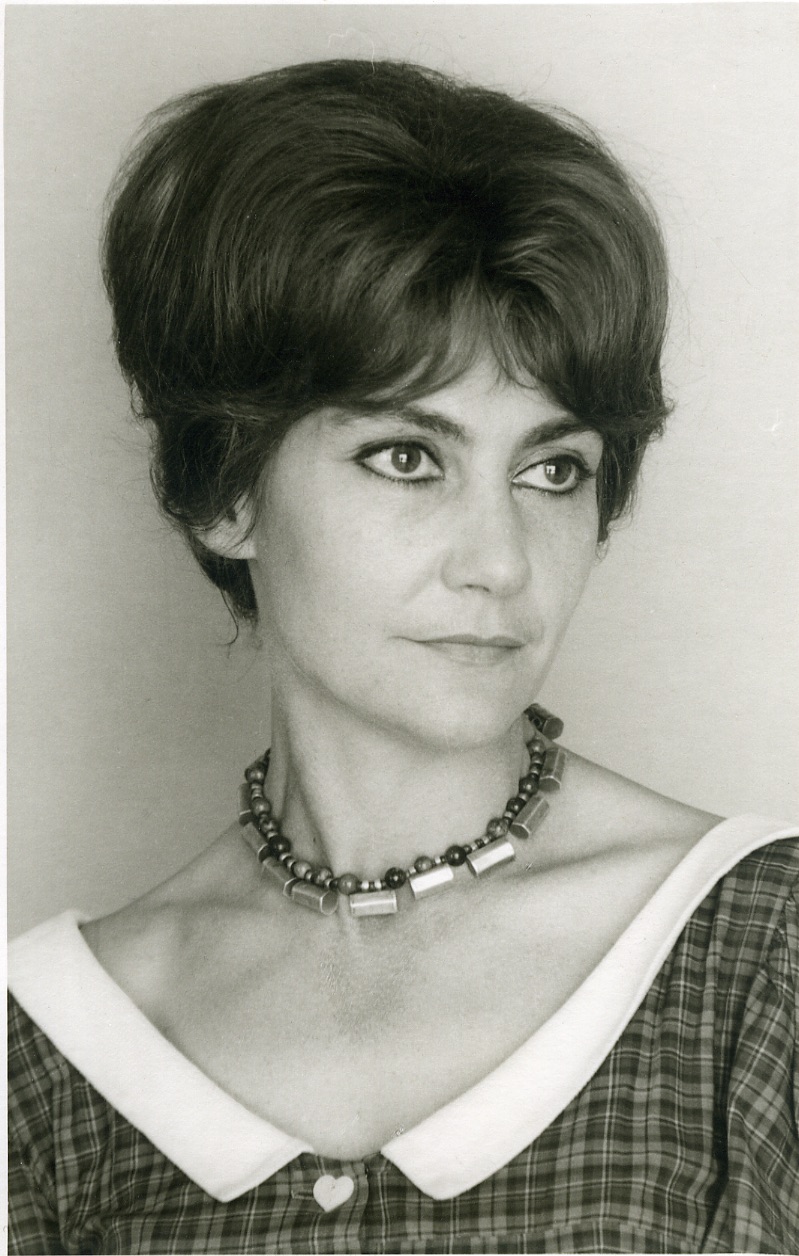
San Francisco, December 10, 2025—Gallery Wendi Norris is proud to announce exclusive representation of the estate of Marie Wilson (1922, Cedarville, CA – 2017, Athens, Greece).
Over the course of six decades, Wilson produced a revelatory and singular body of work that was rooted equally in the cultural and spiritual milieu of Northern California and the Bay Area of her youth, and in the intellectual currents of European surrealism, which she experienced while living and working among the movement’s central figures. Through biomorphic and geometric forms—ranging from semi-abstract arrangements to the exactingly symmetrical compositions of her mature period—Wilson created oil paintings, drawings in ink and pencil, lithographs, and ceramics that explored new surrealist horizons and expanded the possibilities of modern art.
On January 20, 2026, Gallery Wendi Norris will open Marie Wilson: A Poet of Forms and Colors, the first major solo exhibition in San Francisco of her work since 1984, when Lawrence Ferlinghetti presented Apparitions: The Mythical World of Marie Wilson at City Lights Bookstore.
“Many of us will be encountering Marie Wilson for the first time, and yet her visionary work is so confident, so knowing, that it feels as if it has been with us forever,” said Wendi Norris. “Marie’s deep ties to surrealism, marked by the years she spent with such luminaries as Wolfgang Paalen and André Breton, shaped the contours of her artistic experimentations, while her connection to the Bay Area informed many of the spiritual qualities of her practice. The result is a transcendental artistic language that was uniquely her own: a poetic, masterful, and harmonious fusion of the sacred and the surreal.”
About Marie Wilson
Upbringing in California
Marie Wilson was born in 1922 in Cedarville, CA. “I think I was born an artist,” she once said. As a child, she developed a fascination with Native American imagery from her grandfather’s collection of handcrafted Indigenous American artifacts. She received a scholarship to Mills College, Oakland, earning her BFA in 1944, and completed her MFA at the University of California, Berkeley, in 1948. After graduating she remained in the Bay Area to teach art, including at the Oakland Public Museum.
Her introduction to the avant-garde came around 1950 through encounters in Sausalito, CA, with the Greek artist Jean Varda (whom she described as her mentor) and British surrealist Gordon Onslow Ford. These connections immersed her in the intellectual community surrounding the Dynaton movement, founded by Austrian surrealist and theorist Wolfgang Paalen, American artist Lee Mullican, and Onslow Ford.
Early Paintings in Europe
In 1952, Wilson followed Paalen to Paris, where he introduced her to surrealism’s central figures, including André Breton—the principal theorist and co-founder of the movement—Alberto Giacometti, Max Ernst, Marcel Duchamp, Jean Arp, Wifredo Lam, and Pablo Picasso, among other major figures in the European avant-garde.

Photo of André Breton, Wolfgang Paalen, Marie Wilson, and Benjamin Péret, in Saint-Cirq-Lapopie, 1953.
Paalen, notably, exposed Wilson both to automatism and the surrealists’ eclectic weaving of modernism with non-Western art, particularly that of Mexico’s indigenous cultures. Wilson, attuned to the Surrealists’ interest in occultism, alternative spiritualities, and indigenous myth, gravitated strongly toward pre-Columbian mythology as well as the spiritual traditions of Hinduism and Zen Buddhism—interests rooted in her Californian upbringing.
Wilson’s small and semi-abstract paintings from the early 1950s were an amalgamation of Paalen’s lyrical abstraction and Varda’s and Onslow Ford’s mosaic and vaguely biomorphic styles. In Portrait of the Poet in a State of Delirium (1952 – 54), she delineates unclassifiable forms with dotted lines, while hints of landscape emerge in works such as Once in a Blue Moon Landscape (1952 – 54).
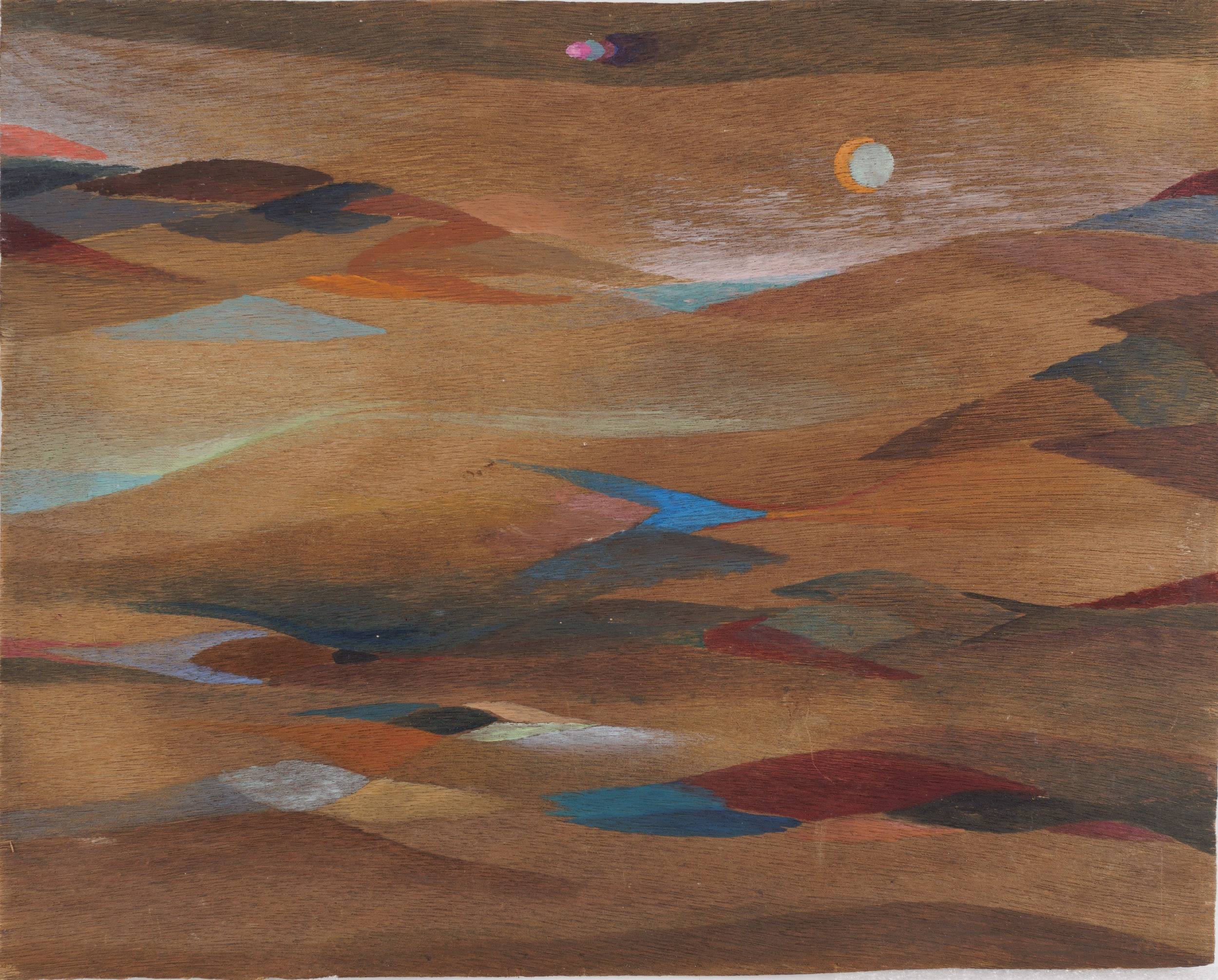
Marie Wilson, Once in a Blue Moon Landscape, 1952 – 54.
Symmetry, Automatism, and the Search for the Sacred
By 1954, Wilson began to develop what would become her signature style: meticulous, symmetrical compositions of striking complexity, clarity, and precision. Summers spent with Breton and his wife in the South of France—playing surrealist games and studying the natural world—introduced her to the mediumistic works of Fleury Joseph Crépin and Augustin Lesage. Indeed, the works of such “outsider” artists, like the tribal artifacts the surrealists collected and admired, were prized within the group as they challenged established Western notions of art and creativity. As Wilson would later recall, seeing “[t]heir work opened up a vision for me, and within a year or two my work became completely symmetrical.”
Influenced by these visionary artists and by the Surrealists’ reverence for tribal and outsider art, Wilson fully embraced automatism, but in a highly deliberate, concentrated manner. Her process, however, differed from the more spontaneous approaches of Crépin and Lesage, as well as others like Yves Tanguy and André Masson. Experimenting prolifically with automatism, she described her method as such:
“When I look at an empty canvas, I go to the center automatically. Usually, I start a little above center, and draw a dot or maybe a little shadow there—something. Then I put another bit to the right and to the left, and then above and then below. It’s like a cross. I work like that, as if I were making lace. I invent it as I go. I am not starting with an idea. I don’t know where or what I am going to do when I begin a drawing or a painting.”
Automatism for Wilson was thus a technique for stimulating creativity and liberating her artistic expression. She began producing highly organized compositions that consciously exploited her creative potential and that allowed her to explore her fascination with the spiritual. She said that her practice (despite appearing as if driven by an invisible compulsion) was laden with an “intensity of concentration.” The sustained focus behind her mediumistic artmaking, therefore, became an almost theosophic practice, a search for the cosmic sacred. She would later attest that, “My work is like charting out an unknown territory.”

Marie Wilson, Spirit of the North Star, 1957-81.
Paintings such as Spirit of the North Star (1957-81) embody her synthesis of influences: Pacific Northwest Coast art, Navajo and Tibetan Buddhist sand paintings and mandalas, the totemic and the cosmic. With its dexterously crafted central anthropomorphic structure blended with avian features, combined with interlocking earth-toned shapes, this work exemplifies Wilson’s meticulous technique and confident, exacting, and ritualistic style.
Nanos Valaoritis, Greece, and Oakland, CA
Wilson's explorations of automatism deepened even further through her collaboration and relationship with the Greek poet Nanos Valaoritis, whom she met in 1954 and subsequently introduced to Breton. Their 1958 collaborative book, Terre de Diamant, paired Wilson’s sixteen automatist mandala-like lithographs with an equal number of poems by Valaoritis written in response to them. Their creative exchange shaped Wilson’s approach and inspired many of her poetic titles.
In 1960, Wilson and Valaoritis married and left Paris for Greece, where they had three children, before fleeing in 1968 during the military dictatorship. Settling in Oakland, CA, Wilson continued her artistic practice, exhibiting in Berkeley, contributing to countercultural reviews and zines, and, alongside her husband, joining the vibrant community of Bay Area surrealists, Beat writers, and intellectuals. At this time, she created most of her work during summers spent at her family home in Greece, where she had the dedicated space necessary for her highly ritualistic methods.
In 1984, Lawrence Ferlinghetti curated a solo exhibition at City Lights Bookstore, Apparitions: The Mythical World of Marie Wilson, marking her last major presentation in San Francisco.
